





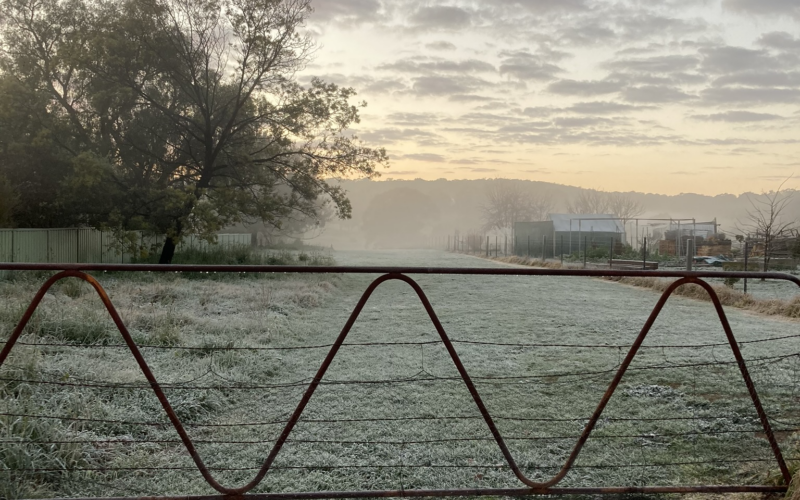
There is no doubt that the Central West is an area of outstanding natural beauty, no matter what the season. It catches you as you crest a hill, or round a corner: rolling hills, distant mountains, strong greens and greys with blazes of colour.
The built and industrial landscape is equally breathtaking, with generations of architectural styles telling the story of our recent history and the activity which shaped it.
In this history: the stone and brick, the old roads, the railway buildings – and the family names which crop up everywhere from graveyards to show trophies to proud family businesses – serve to graciously honour the past, yet not be constrained by it.
As a relative newcomer, the description of someone living in “Bluey’s old place” was a gentle and inclusive nod to the passing of time. It only became a torment in the early COVID period when the likelihood of ever finding the testing facility “on the old Clancy’s site” was vanishingly low. How do you navigate to the “old” place when you don’t know the area, have been given no street location, nor, with obsolete signage long removed, do you have any hope of coming across it by chance?
The answer is as simple as it is crucial to community: you must ask someone. Asking means communication. It means that someone is given the opportunity to help a stranger. It opens up channels and invites reciprocity. This is how neighbourly produce swaps, welfare checks and gentle acknowledgement of shared purpose begin.
Layered on the landscape and the buildings are our collective stories. Where we have come from. What experiences we bring. What attracted us to the region – or what initially drove us away. What passion or ambition or commitment led to the opening of a new business? How much talent, experience and innovation is hidden in the shell of the old butcher’s shop or behind the façade of the modest workers’ cottage?
Small business is the backbone of the Australian economy. Micro-businesses, which are those employing up to four people, were found in 2023 to make up 89% of all businesses in the country and be the fastest-growing segment of the small business ecosystem. In 2025, a subset of these – the solo operators – represent both the fastest-growing segment and the dominant business model. The expectation is that these will stay solo, aided by technology and reluctant to take on the compliance and cost burden of employing staff. This is true despite data showing there is a greater likelihood of survival at the three-year mark for businesses with employees.
What this means is that many business owners now have fewer touchpoints. No staff, no work colleagues, no sounding board or shared loads. To avoid being on the wrong side of the survival statistics, business owners need to fill this human gap.
Luckily, there are options.
Whether formally constituted or casually gathered, in a physical location or on a digital platform, there is a business support ecosystem to suit everyone.
Like the fragile-looking spider webs dotted with dew, our community is held together by resilient threads which stretch and fray but seldom completely break. At times of overwhelm, damage can often swiftly be repaired. Others step up to fill a gap or lighten a load.
Especially in our brisk winters, it is tempting to withdraw into ourselves. But every chance to meet people, to connect and to broaden your circle is an opportunity to find someone who can help you, or someone you can help.
There is never a shortage of challenges in the region and nor is there a shortage of things to appreciate, even though the scale does not always seem to balance. Critical, however, is nurturing and nourishing of community connections, be they through work, sport, social activities or volunteering. If you are business owner, find your tribe and help your business thrive. If you are someone whose community has benefited from the generosity of a small business, don’t just send them thoughts and prayers. Change your buying habits. Support with intent. That, too, is an act of grace.