





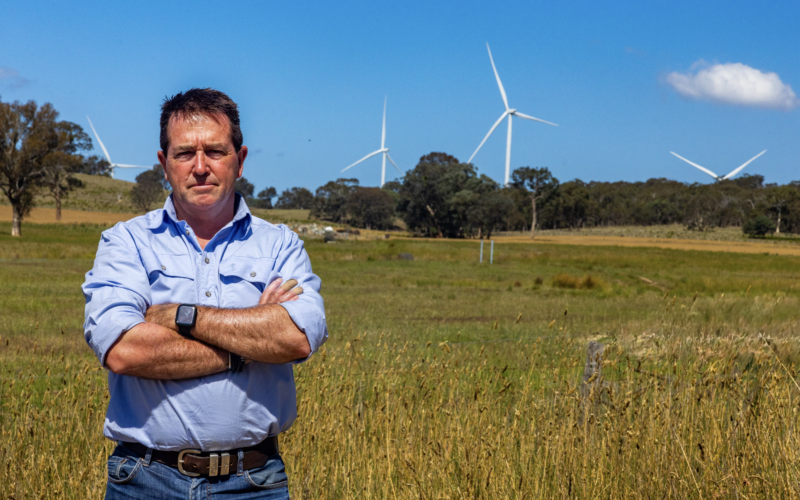
Premier Chris Minns in a recent radio interview has confirmed that landholders could be left responsible for cleaning up renewable energy projects if companies go bust or walk away.
The Premier was asked about a renewable energy project that has been abandoned and now sits as a fire hazard. The Premier said, “The truth of the matter is that the polluter pays in NSW…If the company closes down, it’s the landholder’s responsibility to clean up the site.”
The comments confirm what many farmers across regional NSW have feared, and that the financial risk of these large-scale developments may ultimately fall on local landholders rather than the multinational companies behind them.
Across regional communities, massive wind, solar and transmission projects are being proposed on productive farmland. While these projects are often presented as opportunities for landholders, the Premier’s remarks raise serious questions about who is responsible when projects reach the end of their life or if the company behind them collapses.
Renewable companies are seeking out regional landholders to put their projects on their land, making empty promises and leaving landholders exposed to millions of dollars in clean-up and rehabilitation costs.
Farmers should not be left holding the bill for dismantling turbines, removing infrastructure or rehabilitating land that has been heavily industrialised.
Member for Bathurst Paul Toole said the situation highlights the need for stronger protections for landholders before any agreements are signed.
“Farmers and landholders need to think very carefully before signing up to these industrial-scale projects pushed by multinational companies,” Mr Toole said.
“What is being presented as an opportunity today could become a costly burden tomorrow if the company behind the project disappears.
“Regional communities deserve transparency and protection — not contracts that shift the risk from foreign-owned energy companies back onto local farmers.”
Mr Toole pointed to legislation currently before the NSW Parliament, introduced by the Opposition, that would require renewable energy companies to provide a 50% financial bond upfront before construction begins.
“This bill before the Parliament says these companies must put up a bond of at least 50% up front before they start building, and the remainder paid over the lifetime of the project. That ensures money is there to properly decommission projects and restore the land at the end of their life, without being a burden on our farmers, communities or councils.
“Our bill also eliminates this nonsense of only removing the blades and poles; these changes would mean removing the concrete and rio from the ground as well. These companies have had a free ride for far too long and its time to draw a line in the sand. Enough is enough.”