



The winter solstice is not only an astronomical phenomenon, but a reason for commemoration, celebration or simply quiet observation. Occurring when the poles of the Earth reach a maximum tilt away from the Sun, this creates the shortest day and longest night of the year. In the Southern Hemisphere, it falls on June 21 this year and has quite the historical backstory.
Societies around the world developed ceremonies to mark astronomical events. One of the best-known winter solstice festivals is that of Saturnalia in Ancient Rome, where sacrifices at the Temple of Saturn were followed by banquets with rituals in which norms were ignored or reversed. This included slaves being waited upon by masters, women and men cross-dressing, the lifting of sanctions on gambling and the exchange of gifts.
Possibly a precursor to the greeting card, accompanying the gifts were lines of verse. Perhaps a more tenuous link is with jokey Kris Kringles because, in line with the theme of reversal, the gag gifts were selected for the most significant relationships.
This festival marked the Northern Hemisphere solstice, which occurs towards the end of December. As it was the point when day length began to increase, the renewal of light was celebrated with candles as the coming of their new year on December 25. As the Roman Empire expanded, Saturnalia came to be transformed into myriad observations, including the eventual adoption into Western European customs associated with Christmas.
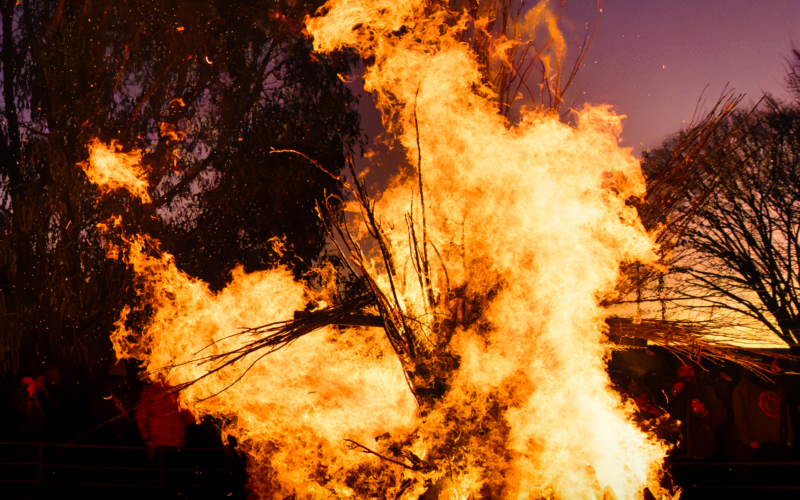
In Portugal, the Careto tradition, believed to have pre-Roman Celtic roots, was first celebrated in the period from Christmas to Twelfth Day and had a rite-of-passage theme. Careto de Podence, a UNESCO-recognised event, is held closer to the equinox (when day and night are equal in length) but with the same symbolism of rejuvenation and the beginning of a new seasonal cycle. Just as in Saturnalia, societal norms are suspended, and in the Careto, chaos is fueled by the anonymity of tin-plate masks. Robes with tassels representing flames foreshadow the finale in which an effigy stuffed with branches and fireworks is set on fire, representing the burning of winter and of bad luck.
Another is St Lucia’s Day in Scandinavia, which links the Christian festival of lights with a Norse tradition of lighting fires to ward off spirits during the longest night. Commemorating St Lucia, a Christian martyr who wore a wreath of candles on her head, it is celebrated on the night of December 12-13, which was, until the calendar changed in 1753, the longest night of the year.
Southern Hemisphere observations of the winter solstice include the Willkakuti (Return of the Sun) festival in South America. Peru’s Inti Raymi symbolised the mythical origin of the Inca people and is celebrated, among other things, to ensure a good harvest. Costumed dances and processions take place at traditional locations and involve the winter solstice motifs of music, masks and feasting.
Possibly pre-dating Stonehenge – those mystical standing stones on England’s Salisbury plain – is the Wurdi Youang stone arrangement in Wadawurrung Country, on Victoria’s western plains. Made up of basalt stones in a semi-oval ring, the stones are positioned to align with the setting sun at the summer and winter solstices, and to separately point towards the setting sun at the equinoxes. The site is described by Elders as a place of balance and renewal, where sky and land speak together. For millennia, it has been a meeting ground for initiations, solstice dances, and the exchange of ochre, tools and cloaks between Wadawurrung and Kulin clans.
In a village much closer to home: the same size as Podence, and on the same continent as Wurdi Youang, a medley of activities and rituals is drawn together at the Newbridge Winter Solstice. Its genesis was a family event grown too large for the backyard, and it now spans village blocks packed with markets, performers and an air of celebration tinged with a hint of costumed mischief. Feasting begins the night before at the medieval banquet, with roaring fires and traditional entertainment. You can even buy your own mini wicker man to throw on the bonfire in Newbridge for a release of bad luck, just as people did three thousand years ago. With the enduring themes of light, renewal and community, winter solstice festivals firmly connect us with other societies across the world, with our past, and with our futures.
By Sarah Hunter