




With the discovery of Gold and the huge rise in demand for Australian wool, authorities recognised as early as the 1850s that the Western Plains of New South Wales were resource-rich with minerals, agriculture and pastoral activities.
But there was a problem. The journey to get these products over the mountains to ports along the coast was arduous, slow and dangerous. The answer seemed simple. Build a railway. But it still took the engineering marvel of a Zig Zag rail line near Lithgow before rail could actually cross the mountains.
Historian Theo Barker in his work (The History of Bathurst, Vol 2) detailed that the coming of the railway in 1876 caused profound changes throughout the district.
It revolutionised the inland city by replacing expensive and dangerous coach or bullock transport with rapid, reliable freight and passenger services to Sydney. A journey between Bathurst and Sydney was reduced from 3 days by coach to just 8 hours by train.
The population of Bathurst virtually doubled (to 10,000) in the twenty years after rail arrived. A new town sprang up, called Milltown, surrounding modern flour mills built next to the railyards. Bathurst quickly became a key transport hub employing huge numbers of people, including drivers, firemen, and cleaners. By 1917, it had become a massive locomotive depot that often held up to 72 steam engines at a time.
The railway became the lifeblood of Bathurst, offering stable employment for a significant portion of the working-class population. During the height of steam (roughly 1880-1950), a staggering one-in-four residents in Bathurst were employed directly on the railways or were dependent on it in some way.
An architecturally outstanding Railway station was placed strategically at the end of Keppel Street, which when lit by its heritage gas lamps, became the magnificent entrance to the booming town of Bathurst. Bathurst had become the premier city of the West.
But apart from the economic bonanza that rail brought to Bathurst, it also brought a beneficial social impact. Education became a major force in the town, with a number of public and church schools growing considerably after the arrival of the railways. The Bathurst Railway Institute (now the Bathurst Rail Museum) provided training and social activities, with the future Prime Minister Ben Chifley working there as an engine driver and union leader up to and after WWI. There were dances, socials and picnics held across town and the Railway Band (now Bathurst City & RSL Concert Band) regularly performed in the purpose-built rotunda within Machattie Park.
Thanks to rail, Bathurst was transformed from a dusty, raucous gold town into a sophisticated, energetic city with bright new buildings, grand parks, gaslit boulevards and numerous cultural institutions.
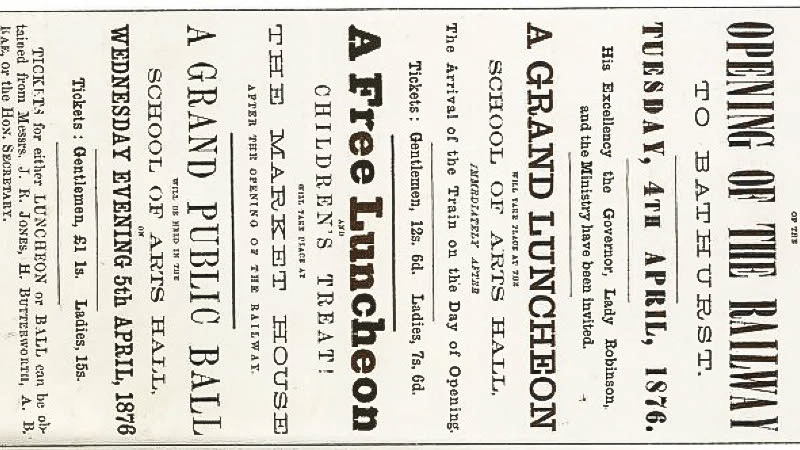
The accompanying poster was published in magazines and newspapers at the time, urging people to attend the opening. The interest was so great that it was reported that 6,000 people turned up on the day of the opening in 1876. The population of Bathurst at the time was less than 5,000!
To experience the age of steam and how important it was for Bathurst, please come to Bathurst Railway Station and the adjacent Rail Museum on Saturday, 6 June 2026. There will be a reenactment of the actual opening of the rail with the arrival of a historic 1917 locomotive at about 11.15 am. The museum will be open to the public, and in the evening, there will be a social dance in the Rail Museum. Steam train rides will be available over the three days of the King’s Birthday weekend. For more details, please visit the Bathurst Rail Museum during open hours or phone them on (02) 6338 2850